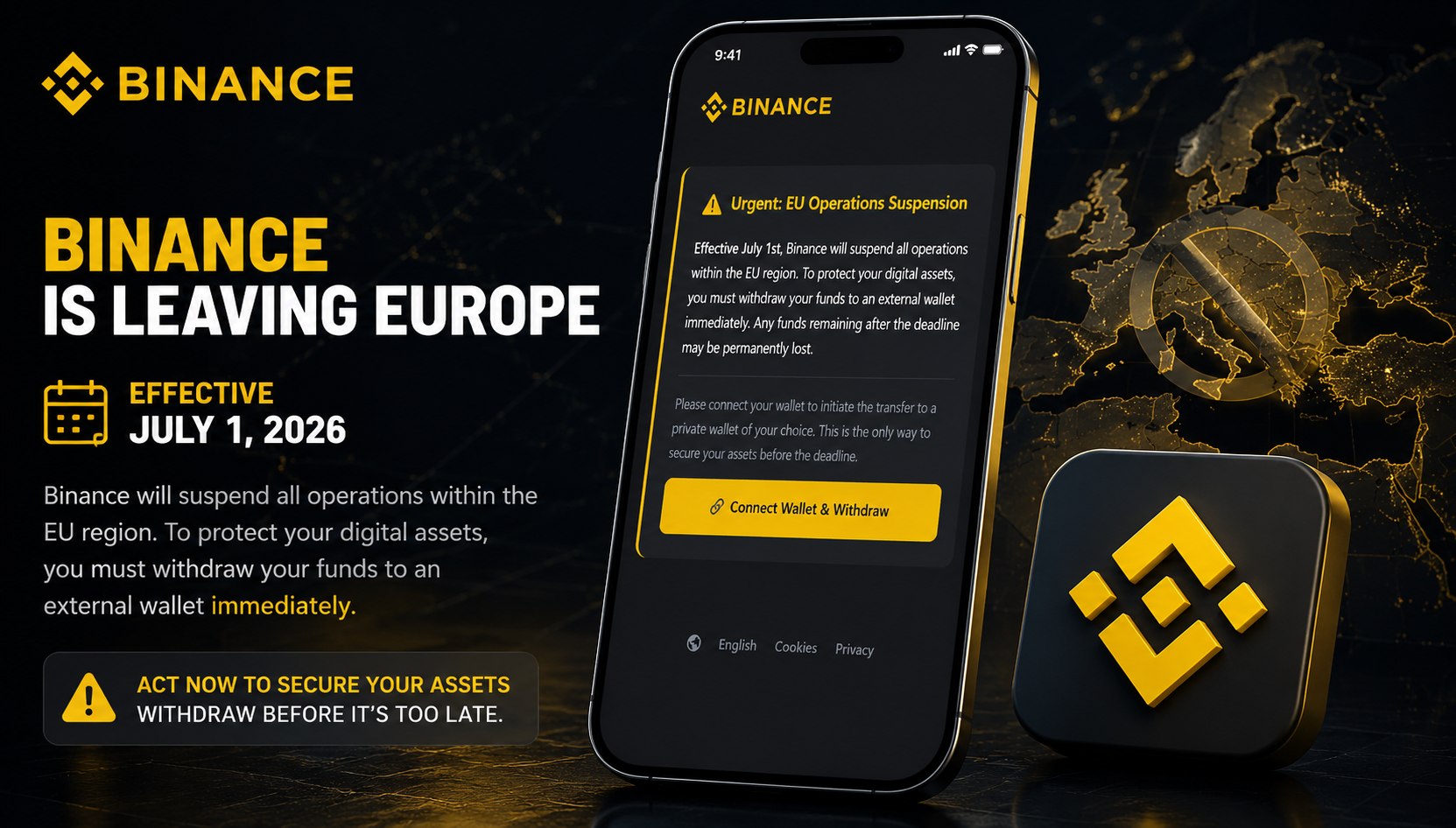
London — Binance, the world's largest cryptocurrency exchange by trading volume, has announced it will suspend services for clients in the European Union starting July 1, 2026. The decision comes after the company failed to secure a license under the Markets in Crypto-Assets (MiCA) framework, a regulatory regime that requires all crypto firms operating in the EU to obtain authorization from a member state's regulator.
The suspension affects users across multiple EU countries, including France, Poland, Italy, and Spain, who received formal notifications from the exchange over the past 24 hours. Binance has assured clients that their assets remain secure and accessible, but strongly urged all affected users to withdraw their funds before the July 1 deadline to avoid service disruptions.
⚠️ Withdraw Your Funds Before July 1
Binance services in the EU will be suspended. Protect your assets — withdraw now.
The regulatory setback stems from Binance's inability to obtain a license from a member state under MiCA, which requires all crypto-asset service providers to secure authorization by June 30, 2026. The company had submitted an application in Greece earlier this year, but withdrew it on June 24 after delays in the review process. Sources indicate that Binance had previously held unsuccessful discussions with regulators in Latvia and Ireland before turning to Greece.
"We have made the prudent decision to move forward in a manner that provides greater clarity for our users and allows us to continue pursuing a long-term, compliant path in Europe," Binance stated in its notification to affected clients. The company has not disclosed which jurisdiction it is now targeting for licensure, though sources suggest France may be under consideration despite having previously investigated the exchange for money laundering violations.
Industry-Wide Implications. The suspension marks a significant escalation in the regulatory pressure facing major cryptocurrency exchanges. Binance has already been forced to exit the U.S. market following a multi-year investigation and settlement, with founder Changpeng Zhao and the company now subject to five years of activity monitoring. The exchange also completed its withdrawal from Russia in late 2023, selling its local business to the little-known platform CommEX, which itself announced it would shut down.
The European suspension is expected to affect hundreds of thousands of users across the continent. Industry analysts warn that the sudden withdrawal of Binance's services could create liquidity gaps in European crypto markets, potentially impacting prices and trading volumes in the short term. However, some experts view the development as a potential boon for smaller, fully-compliant exchanges operating within the EU framework.
"This is a wake-up call for every crypto user in Europe — regulatory compliance is no longer optional, and your funds are only as safe as the license your exchange holds." — Dr. Markus Weber, Financial Regulation Expert
For affected users, the path forward is clear but urgent. Binance has confirmed that all assets remain safe and accessible, but users are advised to initiate withdrawals as soon as possible to avoid potential complications after the July 1 deadline. The exchange has set up dedicated support channels for EU clients and is waiving withdrawal fees for affected users until the suspension date.
What This Means for You. If you are a Binance user in the EU, the most important step is to withdraw your funds immediately. The exchange's services will be suspended on July 1, and while your assets will remain secure, you will not be able to trade, deposit, or withdraw after that date until further notice. Consider transferring your assets to a regulated wallet or to an exchange that holds a valid MiCA license.
The broader crypto community is watching closely as this situation develops. Binance's European exit represents one of the most significant regulatory enforcement actions in the history of cryptocurrency, and its ripple effects will likely be felt across the entire industry for years to come. As the July 1 deadline approaches, the message from regulators and industry observers alike is unequivocal: protect your funds now.